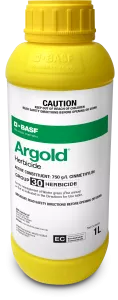
Argold®
Discover gold on every green
Mode of action: Group 30 herbicide
Active ingredient(s): Cinmethylin 750 g / L
Formulation: Emulsifiable concentrate (EC)
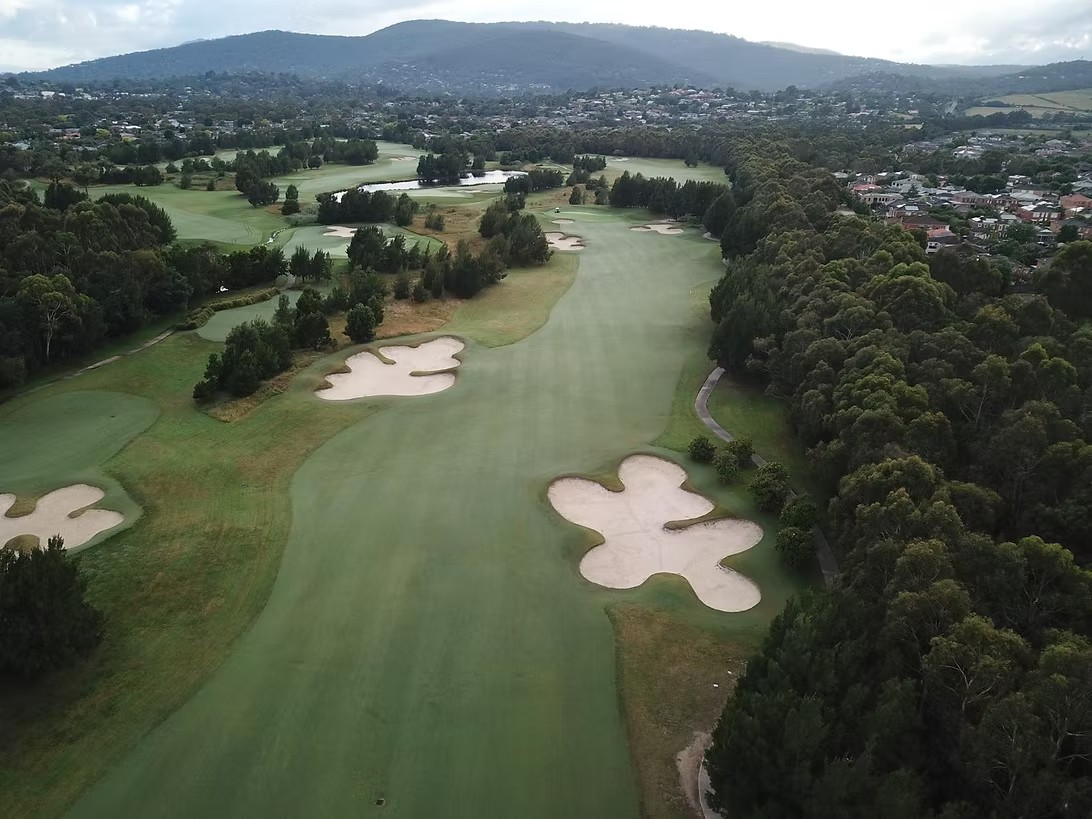
Argold herbicide introduces a powerful new active ingredient for turf managers striving for aesthetic, uniform surfaces. As a highly effective solution for managing Winter grass (Poa annua) in high-performance turf, Argold offers both pre- and early post-emergent control. Its low application rates and flexible program structure allow for effective weed management without compromising playability or premium surfaces.
Argold herbicide is the new gold standard in Winter grass (Poa annua) control for greens of envy, setting a new benchmark for weed management programs on premium surfaces. It delivers high performance, while maintaining exceptional turf quality when label and technical guidelines are followed.
Key benefits
- New powerful active ingredient for the turf industry
- Weed management tool to help achieve aesthetic uniformity on premium surfaces
- Winter grass management solution with pre- and early post-emergent activity
- Flexible application programs which can be tailored to individual site goals and high performing turf
- High efficiency while maintaining playable surfaces
- Safe for use on premium surfaces, including greens, when label and technical directions are followed
How it works
Argold herbicide is a Group 30 Herbicide. Its active ingredient, Cinmethylin, functions by inhibiting fatty acid thioesterase, an enzyme critical to fatty acid biosynthesis in plants. This disruption impairs the formation of essential lipids, leading to cell membrane damage and ultimately plant death. The uptake of Cinmethylin is mainly through the roots of germinating weeds where it disrupts development of weed growing points, roots and shoots.
Product suitability
-
Turf
Winter grass
Frequently Asked Questions
-
How do I select a rate for my Argold herbicide application?
Application programs must be tailored, considering the goals of the surface, and the population dynamics of Winter grass (Poa annua) characteristic of the site. While the label flexibly allows a dual acceleration strategy, technical advice aligns with a conservative approach whereby applications begin at the lowest label rate, 350 ml / ha, and longer re application interval, 6-weeks. For sequential applications, the program design supports end users to make progressive decisions based on symptoms and population decline.
-
Is a small plot test essential for every surface?
Argold herbicide has been tested on a range of turf cultivars without damage. However, some species and varieties are particularly susceptible to chemical products. As sensitivity may be related to local conditions it is advisable that a small test plot of turf is treated first to determine reaction to the product before treating entire surface. Due to the variability of surfaces, even within the same site location, it is recommended that a small test plot of turf is treated on every surface.
-
When should I expect to see the effects of the application?
For early-post emergent treatments, yellowing is typically observed from 3 weeks after application. Typically, 3 consecutive applications are required to yield significant population decline of susceptible weeds. It is important to note that the success of an Argold Herbicide program is not exclusively defined by visual results, in some cases the visual results will be subtle, for example when perennial weed biotypes are treated this may result in a persistent Green skeleton.
-
What is a Green skeleton?
A Green skeleton is a Winter grass (Poa annua) plant which has been treated, likely in a post emergent application, though has not died immediately as a result. Although it still exists, a Green skeleton’s tissue production has been disrupted, typically in the weed seed head. This plant will exist in an impaired state with reduced biomass and vitality for ongoing survival. It is likely this plant will subtly regress overtime.
-
Is Argold herbicide suitable for use in conjunction with PGR, herbicide or renovation programs?
Argold herbicide is not permitted for use in conjunction with Trinexepac Ethyl products and must not be simultaneous with maintenance practices which extensively disturb the soil profile. Applications of Argold herbicide should not be made to turf which has been stressed through disease, insect damage, frost, nutrient deficiencies, or other herbicide use.
-
Can I apply Argold herbicide to other surfaces outside of golf course greens, tees and bowling greens?
Argold herbicide can be applied to other highly managed turf surfaces of Creeping Bent grass (Agrostis stolonifera), Couch grass (Cynodon dactylon), and Hybrid couch grass (Cynodon dactylon x Cynodon transvaalensis). In areas of higher cut situations, e.g. a golf course collar or similar, pre-emergent application timing is critical as this provides the most significant opportunity for Argold Herbicide to impact the weed’s fatty acid production (during germination and early establishment). Post emergent treatment of large, advanced Winter grass (Poa annua) plants in this situation is unlikely to yield favourable results.
-
Why is there variation in weed control symptoms throughout the surface?
A surface naturally includes a diverse population of weeds of different growth stages. Argold Herbicide has greater capacity for impact in newly emerging plants because the rate of fatty acid synthesis is more rapid and more critical. By comparison, in mature tissues of established plants, the demand of fatty acid synthesis is lower because membrane turnover slows down. As a result, some variation in visual symtoms may exist after Argold Herbicide applications.
-
The visual results of the application aren’t obvious, is the product working?
It is important to note that the success of an Argold herbicide program is not exclusively defined by visual results. The expected results, both visual and non-visual, are directly related to the type of treatment (pre-emergent vs. early-post emergent vs. post emergent/perennial biotype). Subtly visual or non-visual results include: ongoing reduction of weed emergence; management of seedbank year-on-year due to declining population and creation of Green skeleton plants which have decreased biomass and seed set, yet still may exist for a period of time following application.
-
The host turf has sustained minor damage from the Argold herbicide application, what is the recommended action?
If any adverse turf safety effects are observed, discontinue further applications until the turf has fully recovered. Although uncommon, minor transient discoloration may occur on the host grass after repeated applications, however, this should recover by 28 days after treatment.
What our customers are saying